================================= NEW ==================================
- Shell and Exxon's secret 1980s climate change warnings The Guardian
In the 1980s, oil companies like Exxon and Shell carried out internal assessments of the carbon dioxide released by fossil fuels, and forecast the planetary consequences of these emissions. In 1982, for example, Exxon predicted that by about 2060, CO2 levels would reach around 560 parts per million -- double the preindustrial level -- and that this would push the planet's average temperatures up by about 2 degrees C over then-current levels (and even more compared to pre-industrial levels).
Later that decade, in 1988, an internal report by Shell projected similar effects but also found that CO2 could double even earlier, by 2030. Privately, these companies did not dispute the links between their products, global warming, and ecological calamity. On the contrary, their research confirmed the connections.
Shell's assessment foresaw a one-meter sea-level rise, and noted that warming could also fuel disintegration of the West Antarctic Ice Sheet, resulting in a worldwide rise in sea level of "five to six meters." That would be enough to inundate entire low-lying countries.
Shell's analysts also warned of the "disappearance of specific ecosystems or habitat destruction," predicted an increase in "runoff, destructive floods, and inundation of low-lying farmland," and said that "new sources of freshwater would be required" to compensate for changes in precipitation. Global changes in air temperature would also "drastically change the way people live and work." All told, Shell concluded, "the changes may be the greatest in recorded history."
For its part, Exxon warned of "potentially catastrophic events that must be considered." Like Shell's experts, Exxon's scientists predicted devastating sea-level rise, and warned that the American Midwest and other parts of the world could become desert-like. Looking on the bright side, the company expressed its confidence that "this problem is not as significant to mankind as a nuclear holocaust or world famine."
The documents make for frightening reading. And the effect is all the more chilling in view of the oil giants' refusal to warn the public about the damage that their own researchers predicted. Shell's report, marked "confidential," was first disclosed by a Dutch news organization earlier this year. Exxon's study was not intended for external distribution, either; it was leaked in 2015.
Nor did the companies ever take responsibility for their products. In Shell's study, the firm argued that the "main burden" of addressing climate change rests not with the energy industry, but with governments and consumers. That argument might have made sense if oil executives, including those from Exxon and Shell, had not later lied about climate change and actively prevented governments from enacting clean-energy policies.
Although the details of global warming were foreign to most people in the 1980s, among the few who had a better idea than most were the companies contributing the most to it. Despite scientific uncertainties, the bottom line was this: oil firms recognized that their products added CO2 to the atmosphere, understood that this would lead to warming, and calculated the likely consequences. And then they chose to accept those risks on our behalf, at our expense, and without our knowledge.
- Wildfires, hurricanes and other extreme weather cost the nation 247 lives, nearly $100 billion in damage during 2018 Washington Post
Since 1980, the United States has experienced 241 weather and climate disasters where the overall damage reached or exceeded $1 billion, when adjusted for inflation, according to data from the National Oceanic and Atmospheric Administration. Between 1980 and 2013, according to NOAA, the nation averaged roughly half a dozen such disasters a year. Over the most recent five years, that number has jumped to more than 12.
Since 1980, the United States has experienced 241 weather and climate disasters where the overall damage reached or exceeded $1 billion, when adjusted for inflation, according to data from the National Oceanic and Atmospheric Administration. Between 1980 and 2013, according to NOAA, the nation averaged roughly half a dozen such disasters a year. Over the most recent five years, that number has jumped to more than 12.
...
NOAA said 14 separate weather and climate disasters, costing at least $1 billion each, hit the United States during 2018. The disasters killed at least 247 people and cost the nation an estimated $91 billion. The bulk of that damage, about $73 billion, was attributable to three events: Hurricanes Michael and Florence and the collection of wildfires that raged across the West.
Yet 2018 did not set the record for the most expensive year for such disasters. That distinction belongs to 2017, when Hurricanes Harvey, Irma and Maria combined with devastating Western wildfires and other natural catastrophes caused $306 billion in total damage. They were part of a historic year that saw 16 separate events that cost more than $1 billion each.
...
Separately on Wednesday, the National Aeronautics and Space Administration and NOAA released data that officially made 2018 the fourth-warmest year since 1880. The last four years have been the warmest on record, and nine of the 10 warmest years have been since 2005. Analyses from NASA and NOAA also show that in most or all of these years, the Earth was at least 1 degree Celsius, or 1.8 degree Fahrenheit, warmer than it was in the preindustrial era of the middle to late 1800s.
"It was quite clearly the fourth warmest year in our record, which goes back to 1880, and probably was warmer than many hundreds of years before that," said Gavin Schmidt, director of the Goddard Institute for Space Studies at NASA, which produces the temperature record.
The agencies' data also showed that 2018 was the wettest in the past 35 years in the U.S., and the third wettest since record keeping began in 1895.
Hsiang said that climate models predict that the country can expect more of the most catastrophic and costly events over time --- namely, more powerful hurricanes slamming into the East and Gulf coasts and more intense wildfires in the West. Scientists also have predicted that a warming climate will fuel more severe droughts, longer wildfire seasons and more frequent floods.
Climate change has helped to shape the severity of at least some of the natural disasters in recent years, said Kerry Emanuel, a top hurricane expert at the Massachusetts Institute of Technology. For instance, Emanuel has published research suggesting the enormous rainfall Hurricane Harvey dumped on Houston was made more possible because of climate change.
However, that's different than saying that the overall aggregate damage figures are definitely rising because of climate change. That hasn't been proven to a 95 percent certainty, Emanuel said, but there are reasons to suspect climate change is playing a notable role.
"If you're assessing a risk, a risk you have every reason to think exists, nobody would ever require that certainty," Emanuel continued. "Generals in the battlefield would never wait for 95 percent certainty."
There are also projections that the impact of climate change should soon be making itself felt in the cost of at least some disasters. A 2014 analysis by the Rhodium Group, for instance, projected that by 2030, the average damage from hurricanes and nor'easters, to the East and Gulf coasts in particular, should be $3 billion to $7.3 billion higher each year. That's if climate change continues unabated.
The trend itself is an unsustainable one, Hsiang said.
"These costs are enormous. If we really continue to sustain costs like this going forward, many elements of the way we've managed resources in society are just not financially sustainable," he said. "We are spending huge amounts of money on disaster relief . . . We're always responding to a disaster by picking up the pieces after they occur."
The distribution of damages from billion-dollar disasters has long been dominated by hurricanes, which can wreak havoc over multiple large states and millions of people in a matter of hours. Since 1980, hurricanes traditionally have caused more than half the total losses tallied by the government. But the Camp Fire in the fall, which became the deadliest and most destructive wildfire in California history, also fueled a historically damaging wildfire season. NOAA estimated that wildfires accounted for $24 billion of damage last year, well in excess of the record of $18 billion, set in 2017.
While fires and hurricanes are responsible for the bulk of disaster-related damages --- and also disaster-related headlines --- a number of other events also routinely have surpassed the billion-dollar mark over the years. They include droughts, hailstorms, winter storms and tornadoes.
And while calamities have struck nearly every corner of the country, climate change is likely to make the impact disproportionate going forward --- not just from hurricanes and other storms, but also from economic losses associated with an ever-growing number of hotter days.
"There's no doubt, the Southwest is the epicenter of negative economic impacts in coming decades," Muro said. "In the big picture, the Southeast and the Gulf Coast are the center of climate harm in the United States."
- Billion-Dollar Weather and Climate Disasters: Table of Events NOAA
Below is a historical table of U.S. Billion-dollar disaster events, summaries, report links and statistics for the 1980--2019 period of record. In 2019 (as of October 8), there have been 10 weather and climate disaster events with losses exceeding $1 billion each across the United States. These events included 3 flooding events, 5 severe storm events, and 2 tropical cyclone events.
- Billion-Dollar Weather and Climate Disasters: Overview
Found here are the weather and climate events that have had the greatest economic impact from 1980 to 2019. The U.S. has sustained 254 weather and climate disasters since 1980 where overall damages/costs reached or exceeded $1 billion (including CPI adjustment to 2019). The total cost of these 254 events exceeds $1.7 trillion.
In 2019 (as of October 8), there have been 10 weather and climate disaster events with losses exceeding $1 billion each across the United States. These events included 3 flooding events, 5 severe storm events, and 2 tropical cyclone events. Overall, these events resulted in the deaths of 39 people and had significant economic effects on the areas impacted. The 1980--2018 annual average is 6.3 events (CPI-adjusted); the annual average for the most recent 5 years (2014--2018) is 12.6 events (CPI-adjusted).
2019 is the fifth consecutive year (2015-2019) in which 10 or more billion-dollar weather and climate disaster events have impacted the United States. Over the last 40 years (1980-2019), the years with 10 or more separate billion-dollar disaster events include 1998, 2008, 2011-2012, and 2015-2019.
- Why Scientists Trust the Surface Thermometers More than Satellites climatecrocks.com
- How Reliable are Satellite Temperatures?
- Satellite or Surface Temps: Which is More Accurate?
- Satellite Scientist: Surface Temp Measures are More Accurate
================================= OLD ==================================
- Larry's Youtube video Fox News Mark Leven and Patrick J. Michaels The youtube video was posted on Oct 21, 2018
- Transcript of the Oct 21 Fox News Mark Leven and Patrick J. Michaels program
- Patrick Michaels wikipedia article
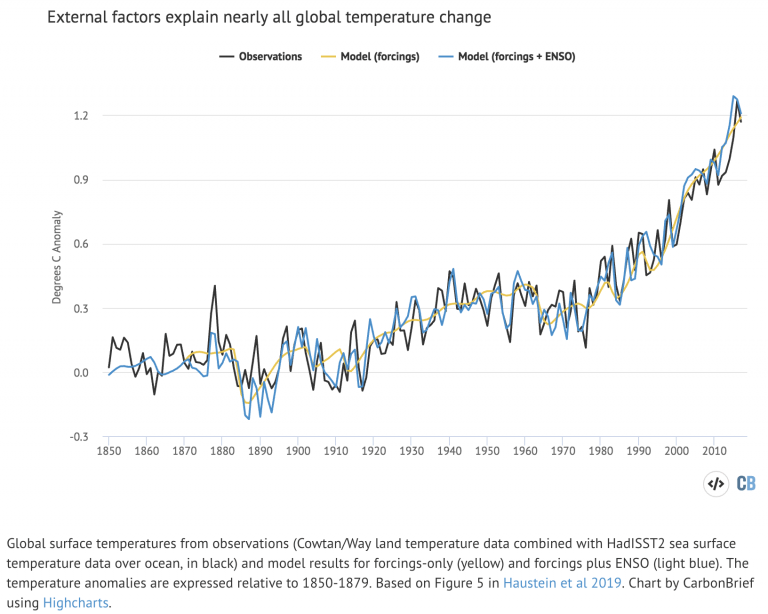
--- In 2018, Michaels asserted on Fox News, "probably about half, maybe half of that nine-tenths of the degree [of total warming] might be caused by greenhouse gases." Climate Feedback, a fact-checking website for media coverage on climate change, wrote of Michaels' assertion, "no evidence or research is provided to support this claim, which contradicts the published scientific literature."
--- On July 27, 2006 ABC News reported that a Colorado energy cooperative, the Intermountain Rural Electric Association, had given Michaels $100,000. An Associated Press report said that the donations had been made after Michaels had "told Western business leaders ... that he was running out of money for his analyses of other scientists' global warming research" and noted that the cooperative had a vested interest in opposing mandatory carbon dioxide caps, a situation that raised conflict of interest concerns.
--- Michaels said on CNN that 40 per cent of his funding came from the oil industry. According to Fred Pearce, fossil fuel companies have helped fund Michaels' projects, including his World Climate Report, published every year since 1994, and his "advocacy science consulting firm", New Hope Environmental Services.
- On Fox News, Patrick Michaels falsely claims humans are only responsible for half of global warming Review of the Mark Levin program, published July 9, 2019
--- Claim: "So that means that probably about half, maybe half of that nine-tenths of the degree [of total warming] might be caused by greenhouse gases"
--- Verdict: INCORRECT
--- much details and data
- Desmog blog bio on Patrick Michaels
--- In a leaked 2006 memo of the Intermountain Rural Electric Association (IREA), Michaels is listed as a recipient of at least $100,000 from IREA to combat global warming "alarmists." The IREA memo outlines a coordinated strategy by Koch Industries, the Competitive Enterprise Institute, Michaels, and other key groups. "We have met with Koch, CEI and Dr. Michaels, and they meet among themselves periodically to discuss their activities," NERA's General Manager Stan Lewandowski wrote.
--- Patrick Michaels founded the consulting firm New Hope Environmental Services. Michaels described (PDF) the firm's purpose as to "publicize findings on climate change and scientific and social perspectives that may not otherwise appear in the popular literature or media. This entails both response research and public commentary."
--- SourceWatch describes New Hope Environmental Services as "in effect ... a PR firm." New Hope is secretive about its funding sources, and fought a Greenpeace motion seeking disclosure. It is known to have received funds from electrical utilities in the past.
--- New Hope Environmental Services also ran a climate change bulletin titled The World Climate Report which was edited by Patrick Michaels and funded by coal group Western Fuels Association.
--- Analysis of the tax records of the Cato Institute found that in 2006 and 2007 the think tank paid Michaels' New Hope more than $240,000 in fees.
--- Patrick Michaels & Tobacco
--- Pat Michaels was a "member scientist" and "individual supporter" at The Advancement of Sound Science Coalition (TASCC), an organisation created and funded by the tobacco industry to fight anti-tobacco legislation.
--- Michaels was also an "Academic Member" of the European Science and Environment Forum (ESEF), a group created by the tobacco industry to frame legitimate science as "junk science" on matters pertaining to health and environment, particularly secondhand smoke health impacts. Michaels was listed as an academic member on the ESEF's March 1998 working paper titled "Environmental Tobacco Smoke Revisited: The reliability of the evidence for risk of lung cancer and cardiovascular disease."
- That Global Warming Hiatus? It Never Happened. Two New Studies Explain Why. Inside Climate News
The United Nations panel of climate science experts mentioned it in a 2013 report, scientists have published more than 200 papers analyzing it, and climate deniers said it was proof that climate change didn't exist, but in reality the global warming "pause" or "hiatus" never occurred.
...
"There was a natural slowdown in the rate of warming during roughly the decade of the 2000s due to a combination of volcanic influences and internal climate variability, but there was no actual 'hiatus' or 'pause' in warming," Michael Mann, director of the Earth System Science Center at Pennsylvania State University and an author of the climate modeling study, said.
- Most Credible Climate Skeptic Not So Credible After All
Mother Jones article about Patrick Michaels
With climate science increasingly under siege, Michaels has been getting plenty of airtime lately. Following reports of errors and sloppy research procedures with the reports produced by the Intergovernmental Panel on Climate Change, Michaels featured prominently in a CBS News report last month, claiming that there is "no doubt the trust in the UN panel has been undermined." And after hacked emails revealed that a group of climate scientists had tried to block skeptical views from academic papers and journals, Michaels appeared on CNN's Anderson Cooper 360 to debate Bill Nye (the "Science Guy"). Michaels said he was "troubled" that scientists at the heart of the controversy might have tried "to hide things" from Freedom of Information Act requests. He was also featured prominently in a New York Times piece calling the controversy "a mushroom cloud" for climate science, and appeared several times in the Wall Street Journal complaining that scientists said mean things about him in the emails. (It's worth emphasizing that while the incident revealed scientists behaving unprofessionally, nothing in the emails undermined the underlying science of climate change.)
But Michaels' credibility on climate is called into question by a trove of documents from a 2007 court case that attracted almost no scrutiny at the time. Those documents show that Michaels has financial ties to big energy interests---ties that he's worked hard to keep secret. Here's the back story:
Several years ago, the auto industry launched a salvo of lawsuits challenging the tougher vehicle emissions standards that had been introduced in many states. In 2007, Michaels was scheduled to appear as an expert witness on behalf of a challenge by Green Mountain Chrysler-Plymouth-Dodge and the Association of International Automobile Manufacturers to emissions standards in Vermont. The auto industry's lawyers planned to put Michaels on the stand as an expert witness who would question the scientific finding that greenhouse gas emissions are warming the planet. But it soon became clear that lawyers defending Vermont's law were going to ask Michaels about the clients of his "advocacy science consulting firm," New Hope Environmental Services.
Michaels had never made a list of his clients public, and he refused to do so now, arguing that it was a confidential matter. The judge disagreed, and ruled that Michaels' clients were a "viable area of cross examination." "I understand that maybe it's a little embarrassing," said Judge William K. Sessions III. "[But] it's not highly confidential information."
In a rare move, the auto dealers pulled Michaels off their witness list. In an affidavit [PDF], Michaels stated that New Hope was his primary source of income, and being forced to reveal its clients would "imperil my livelihood." He emphasized that the "sole reason" he did not testify was "concern that my trial testimony would result in the loss of confidentiality for the New Hope information."
The auto lawyers were "desperate to shield who Pat Michaels makes his money from," David Bookbinder, chief climate counsel for the Sierra Club and one of the lawyers for the state in the case. "It's beyond unrealistic," said Bookbinder. "It's like saying in a speeding case that you're not able to ask about how fast someone was going."
As it turned out, Michaels' attempt to keep his client list secret wasn't entirely successful. The court documents reveal that lawyers for the defense saw records revealing that Michaels had received money from at least one very large energy company.
In addition, Greenpeace recently obtained an older copy of Michaels' curriculum vitae via a Freedom of Information Act request that shows that the Western Fuels Association, a coal and fuel-transportation business group, gave him a $63,000 grant in the early 1990s for "research on global climatic change." He also received $25,000 from the Edison Electric Institute, an association of electric utilities, from 1992-95 for "literature review of climate change and updates." And a 2006 leaked industry memo revealed that he received $100,000 in funding from the Intermountain Rural Electric Association to fund climate denial campaigning around the time of the release of An Inconvenient Truth. Reporter Ross Gelbspan wrote in his 1998 book The Heat is On, one of the earliest works documenting industry funding for climate change skepticism, that Michaels also received $49,000 came from the German Coal Mining Association and $40,000 from the western mining company Cyprus Minerals.
In the Vermont case, the auto dealers eventually replaced Michaels with John Christy, an atmospheric scientist at the University of Alabama in Huntsville who believes that concerns about global warming might be overstated. However, Christy proved to be a far less agressive defender of that view than Michaels. According to court transcripts, Christy eventually admitted on the stand, "The increase in carbon dioxide in the atmosphere is real. It is due primarily to the burning of fossil fuels." Vermont went on to win the case and eventually the Environmental Protection Agency not only granted states the right to set those higher emissions standards but adopted the stricter rules nationwide.
Michaels is still frequently called on as an expert source by mainstream media outlets. Even as he's bashed the IPCC for its lack of transparency, he refuses to come clean about the sources of his funding. It turns out the climate skeptics' most credible expert isn't so credible after all.
- historical CO2 vs TEMPERATURE DATA
- Comments
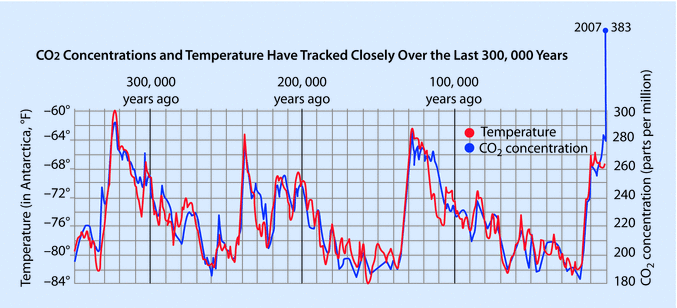
- 350,000 year CO2/Temp record from ice cores
- notice CO2/temp correlation occurs pretty well throughout the period up to about 200 years ago
- Upswings:
- peak at about years -320,000, -240,000, -130,000, -10,000
- upswings are relatively quick (about 10,000 years) and relatively linear
- driven by double feedback
- CO2 raises temp, warming oceans
- warmer oceans release more dissolved CO2, raises CO2 level
- in all of upswing on the chart, the upswing stops as remaining dissolved CO2 in ocean approaches zero
- current temp upswing (just beginning, not shown on chart) will not stop for that reason, because we have added so much CO2
- Downswings:
- slower, more complex process
- ice has melted, trees grow, absorbing C from CO2. reducing CO2
- less CO2 lowers temperature
- eventually, ice reforms, kills trees, streams carry decay to ocean
- decay yeilds CO2 in ocean, ready for new upswing
- Human using agricuture occurs at about -10,000 years:
- ENTIRE human mass agricuture period between last 2 vertical lines on graph
- starts at the peak of last upswing
- we have no human experience w/agriculture DEPENDENCE outside of about a 2 degree F span
- CO2 first exceeded 300ppm about 100 years ago. It is now above 410ppm
- This puts CO2-temp correlation WAY OUT OF WHACK, relative to any other period on this chart
- From feedback activity on upswings in this chart, we know that temp can raise CO2 to get chart back in sync (until the ocean runs out of dissolved CO2), and CO2 CAN RAISE TEMP to get the chart back in sync
- On this chart, 100ppm change in CO2 corresponds to about 20 degrees F change in temperature
- At that rate, the temp change required to bring temp into correlation with CO2 level of 410ppm would be:
- (410ppm-260ppm)*(20 degrees F/100ppm)=30 degrees F temp rise, relative to start of human agriculture period
- 30 degree F temp rise is clearly a DISASTER for humanity
- The above analysis is a somewhat pessimistic, because Temp and CO2 should probably be graphed on a logarithmic scale, rather than a linear scale. But from the chart, we have direct HISTORICAL data that correlates 290ppm with an 8 degree F temp rise, and 410ppm is clearly worse than that. 8 degree F temp rise also spells a clear DISASTER.
--- but, it takes time to bring temp up to match CO2 concentration. Recall upswings on chart took 10,000 year. We are only 100 year into the "above 300ppm" condition. So measuring today temp doesn't reflect where temperature is ultimately headed, simply as a result of the CO2 that is ALREADY UP THERE (and which will stay there). (Also, it isn't going to take anywhere near 10,000 years to get major effects of current CO2 - temp miscorrelation -- the process will be accelerated because the degree of mis-correlation is so extreme.)